
What Does It Mean to “Vote Socialist”?
SMC Editorial Board Note: This piece is not an official caucus statement, but the opinion of the author. It is part of a larger series of articles examining the impact of Zohran Mamdani’s historic mayoral campaign and administration upon DSA and the American Left in advance of the 100th day of Zohran’s administration.
Leftists should never do anything to sabotage the success of a leftist organization when that organization's strategy is winning tangible, material gains for the working class. A hurdle to a leftist victory is a hurdle to the workers all socialists seek to liberate, which also means socialists should condemn those that commit themselves to a doomed electoral strategy.
It is well known that NYC-DSA was central to the Mamdani campaign. It is also no secret that NYC-DSA’s success has elevated the electoral work of other DSA chapters across the country. DSA nationally endorsed 22 candidates in 2025, and 13 of those endorsed candidates won, coming to a win rate of nearly 60%! This does not include the dozens of other locally endorsed socialists that took office across the country in 2025, all thanks to their chapters’ work and buoyed in part by the “Mamdani Momentum”. However, DSA is not the only organization to try and use Zohran’s win to bolster their own project.
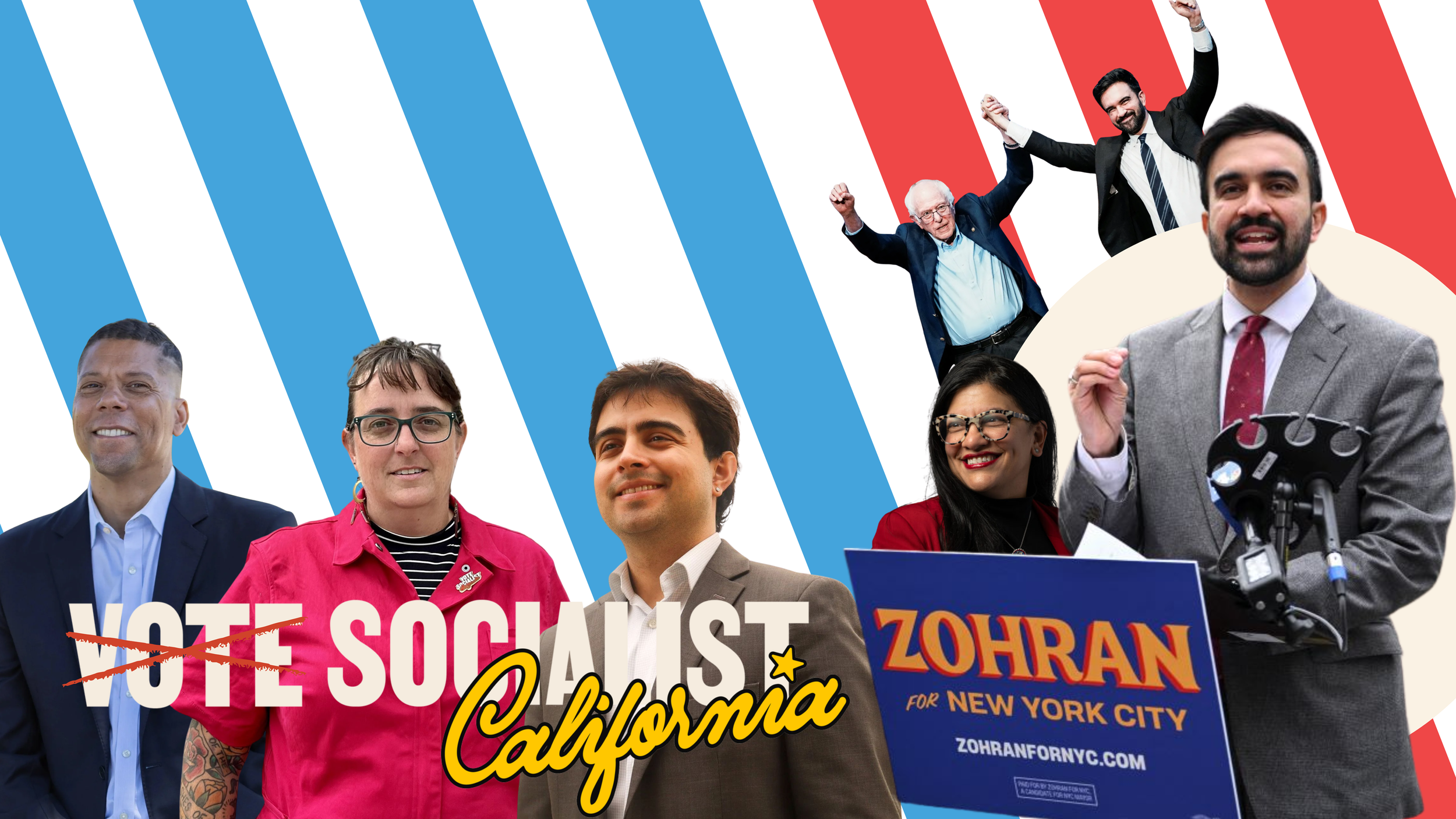
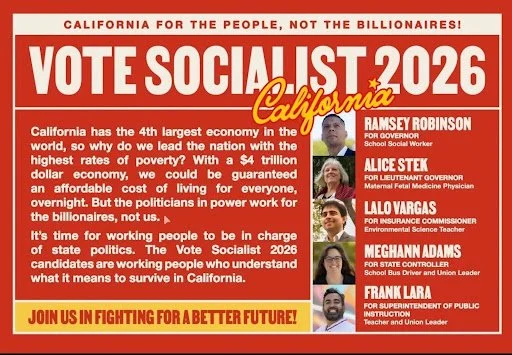
In California, the “Vote Socialist” slate is being pushed by the Party of Socialism and Liberation (PSL) and the Peace and Freedom Party (PFP)—both of which are riding the wave of Zohran Mamdani’s victory in New York City to increase their presence. The PSL and the PFP, both of which have never won a contested election in recent memory, continue to push a third party and so-called “agitational” electoral model with the performative Vote Socialist slate. Their strategy relies on socialist identitarianism, (i.e. vote for me because I am the only “real” socialist running, etc.) instead of attaching the needs of the working class to the platform of a candidate and movement the way Mamdani and NYC-DSA have.
The always failing third party ballot line electoral strategy of PFP/PSL has been their strategy in every previous election. This problematic history of strategy does not indicate that these “socialists” take elections or building power seriously and they have failed to learn from both DSA’s electoral successes and their own electoral failures. And yet, they remain committed to this strategy, even though it is extremely rare for a PFP candidate to pull in a margin larger than 5% in any race.
These efforts to push their unsuccessful electoral model only make it harder for organizations that are building the mass movement needed to replicate the success of Mamdani and NYC-DSA. Many who are new to leftist spaces and organizing might be ignorant about the differences between DSA and PSL’s models of socialism and the Vote Socialist slate’s imitation of pieces of DSA’s messaging and graphic design seem intended to obfuscate the very real differences between our organizations and our tactics.
There is a long history of leftist organizations creating unnecessary obstacles to organizing the working class by pushing a losing electoral strategy. From 2018 to 2021, there was an ad hoc organization established to get more democratic socialists elected to office called the Rose Caucus. The Rose Caucus was formed by a handful of socialist organizers, most of whom were unaffiliated with any organization.
Ahead of the 2020 cycle, the Rose Caucus endorsed a large slate of candidates for public offices, mostly for Congress, who were explicitly self-described "Democratic Socialists". Some of these candidates were DSA members, most were not, and almost all of them were unsuccessful. No one on their congressional slate won or even came close to making it past the primary.
A major reason for the Rose Caucus's failure was their attempt to bank on the success of another organization without contributing to it. That organization was, once again, DSA, and the success they were trying to mimic was that of the Bernie Wave that bumped DSA membership at the time, and the success of candidates DSA elected to Congress between 2018 and 2020, including Cori Bush, Rashida Tlaib, and Alexandria Ocasio-Cortez.
Unlike Bush, Tlaib, or AOC, the Rose Caucus candidates were not deeply rooted in their communities, most lacked any kind of organizing or electoral experience, and ran primarily on their identitarian lines.
Much like the Vote Socialist slate, the Rose Caucus used imagery and branding similar to DSA’s—mainly, the rose, which is the symbol of Democratic Socialism and has been DSA’s logo since 1982. All of the Rose Caucus's candidates were self-described Democratic Socialists and the organization emphasized its promotion of democratic socialist candidates and values. This is no coincidence and was an obvious attempt to ride the wave of democratic socialism that DSA and Bernie helped create. But why did the Rose Caucus create a secondary Democratic Socialist organization to compete with an already successful one instead of joining the existing project and building on that success?
The Rose Caucus has since gone defunct and their last endorsement was for Lee Carter in his unsuccessful and quixotic race to be Governor of Virginia in 2021. Carter also failed to win re-election to his own legislative seat and has since mostly resigned from the public sphere. While the intentions of the organization might have been good, its candidates ran on socialist identitarian politics instead of connecting socialist policies to the needs of the electorate.
The impact of their actions was a deterioration of momentum for socialist candidates that we are still recovering from. Many were excited about the idea of democratic socialist challengers running to oust powerful establishment Democrats, especially those in Congress. But, when the votes came in and the Rose Caucus's losses came in at such wide margins, several well-intentioned socialists were left despondent and drained of energy, especially after Bernie Sanders lost the 2020 primary in addition to these losses. Leftists soon saw a course correction that redirected our efforts from loftier, idealist campaigns for Congress and more towards local and municipal races, which eventually led us to Zohran Mamdani’s victory.
Of course, losing campaigns can still build momentum and infrastructure for future campaigns, but this is extremely rare - so rare it is negligible when compared to what a winning campaign victory yields, as exemplified by Zohran’s win. Further, the few instances where a losing campaign still builds infrastructure tends to happen in races where the margin of victory was incredibly close. When a candidate loses by a couple hundred votes, like Sacramento DSA’s endorsed candidates did in 2024, organizers can still see a better future on the horizon, which is why the chapter’s electoral committee carries on today. When a campaign loses by 20-40%, most organizers become jaded and quit, like Lee Carter himself after his losses.
The energy that the Rose Caucus wasted was energy that could have been channeled into DSA’s successful program, a program that is seeing real results as I write this. We won in New York and continue to win as Mamdani puts democratic socialist policies into practice with policies and programs like his response to the blizzards or his fight for universal childcare.
Running openly as a socialist is one thing but actually building power for the working class requires connecting socialist politics to people’s material needs. While groups like the Rose Caucus and the Vote Socialist slate try to do this with a platform of various policies that sound great on paper, they offer no strategy beyond just "Voting Socialist,"and they only detract from DSA's potential success by creating unnecessary competition amongst the existing socialist voter, volunteer, and small-dollar donor base.
As ICE murders civilians, as journalists are arrested, detained, or shot, as freedom of speech is trampled, as the drum of imperialist wars beat on, and as we struggle to survive, self-proclaimed working-class organizations should not get in the way of building real working-class power. There is too much at stake right now, every organization that claims to be for the working class must put the working class’s needs first, not idealism. It is a material reality that NYC-DSA's current electoral model is successful and that the working class of New York City is seeing material improvements because of it. It is also obvious that the PSL/PFP strategy is a losing one that delivers minimal gains (if any) for workers.
It is imperative that socialists don’t just “Vote Socialist” or flex their ideals, they must commit themselves to a robust strategy of winning elected office and power for the working class.