
Clouds Over Havana
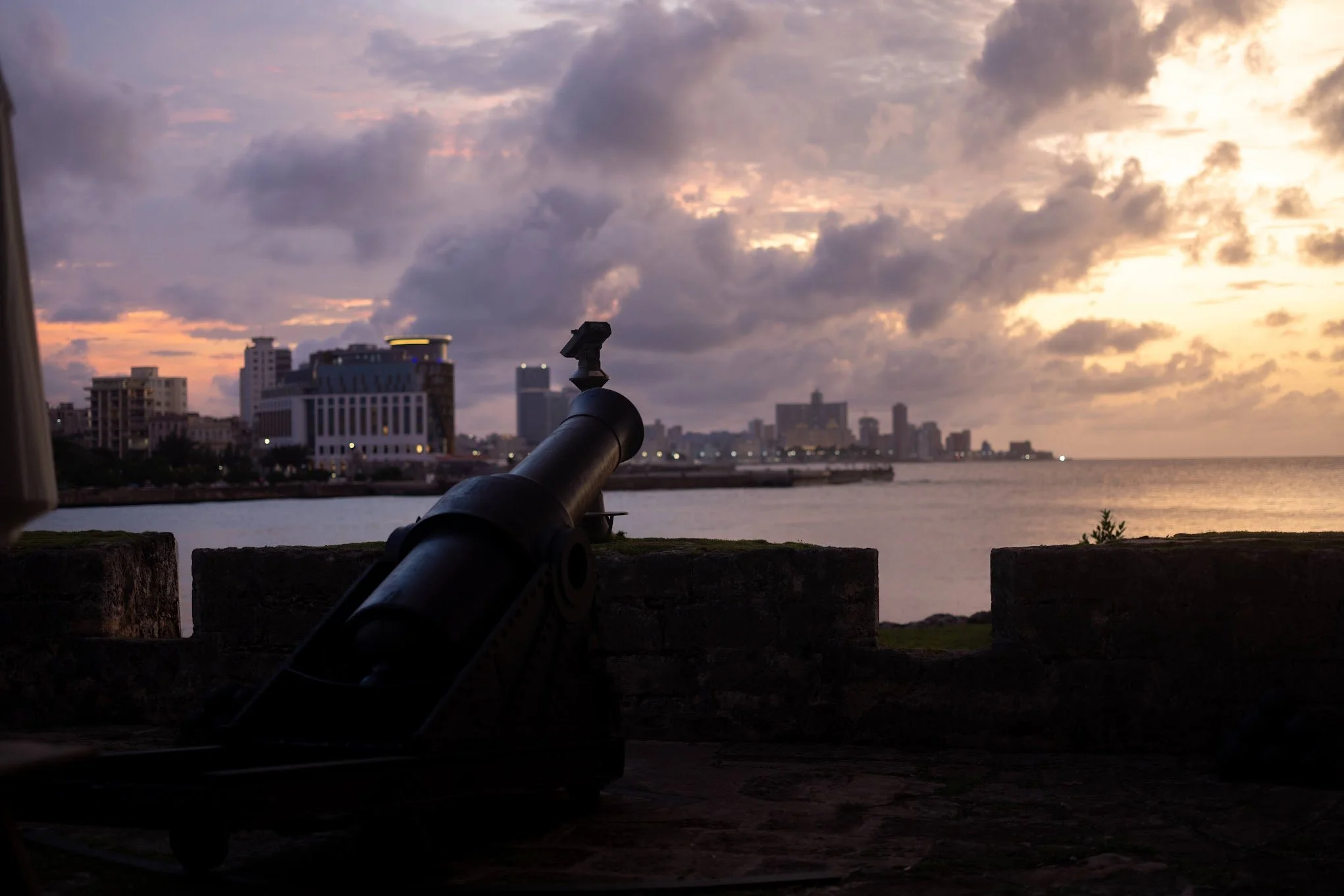
A view over Havana harbor on the delegation’s first night in Havana. | Photo by Brandon Tizol. | Accessed from democraticleft.dsausa.org
SMC Editorial Board Note: This piece is not an official caucus statement, but the opinion of the author and is republished from Democratic Left.
The clouds over Havana were dark as soot on the first morning of DSA’s 2025 delegation to Cuba. Torrential rain beat against the hotel dining room’s windows as our group of 40 introduced ourselves over cups of coffee in rapid succession. Breaking the ice, we joked at how the tropical island resembled Mordor.
For most of us, this was the first time we had set foot inside Cuba in our lives. For others, it was also their first time traveling abroad as representatives of DSA. For me, this was my third delegation with DSA. I knew I would participate in a delegation this year, but I did not know where. My limited PTO forced me to choose between this and a return to my family’s homeland for the Chilean presidential election. This difficult decision sat with me for most of the year. I had spent a large portion of the previous two years as co-chair of the International Committee (IC) Americas subcommittee, working with the co-chairs of the Cuba Solidarity Working Group, to develop this program. Then I was elected to the National Political Committee (the NPC — DSA’s primary political leadership) at the August convention. Now, I had the opportunity to use my newfound role on the NPC to be on the ground, and not only ensure the delegation’s success, but also take advantage of an opportunity to witness Cuba with people who I want to witness Cuba with. Together with my comrades, we could study the Revolution, experience its present conditions under blockade, and process the two together.
This was the second delegation that the Cuba Solidarity Program has conducted. Our group consisted of both national co-chairs, both YDSA co-chairs, leading members of several national committees, at-large members of the NPC, and Cuban members of DSA. We represented a broad cross-section of the organization’s organizing experiences and political perspectives. For four days, we were united by our solidarity with Cuba. This unity makes this project our organization’s leading example of internationalism, and makes DSA the most powerful and capable supporter of the Cuban cause in the U.S. Left.
DSA allows its members the right to interpret the policies of the current Cuban government, discuss the legacy of the Cuban Revolution, and the progress made under socialist governance as they wish. By rooting our internationalism in a pluralistic and democratic process, we can develop the campaigns, communications, and internal organizing needed to oppose the U.S. government’s imperial ambitions. As the fate of Cuba and its revolution grows more perilous, we realize that we need to build on the already-existing networks of solidarity and develop even more approaches to stop Secretary of State Marco Rubio from following through on his ideological commitment to destroying Cuba.
We had just one non-negotiable position for participants: opposition to the U.S. blockade against Cuba.
The Blockade and the Persistence
The blockade refers to Washington’s policy towards Cuba for the past 60 years: economic isolation that leaves Cubans without access to basic humanitarian supplies or the capital needed to renovate its infrastructure. The first Trump Administration escalated this economic sanctions campaign to far deeper effects under its “maximum pressure” doctrine. Cuba is disconnected from global financial institutions and depleted of capital and foreign investment. Due to restrictions on imports, it must ration fuel and limit its ability to provide basic services for citizens. These facts became apparent as our bus traveled through the west end of Havana. We could see the uncollected garbage clogging street drains, causing local flooding. This was our first of many reminders of the hard choices societies under siege have to make on a day-to-day basis.
The sun began to peek through the clouds, allowing the colorful facades of the Calixto Garcia Medical Complex to shine as our bus slowly pulled into the campus. Originally a medical barracks during the Cuban War of Independence (Spanish-American War), it became the country’s largest hospital and medical research campus in 1943 and remained so after the 1959 Revolution. It is now used for medical research, complex surgeries, and treating severe trauma as part of a multi-tiered national public health service. Cuba’s health service is primarily rooted in the local and provincial levels, staffed by doctors who live within their communities and regularly provide their neighbors with free services and regular consultation.
This system depends on a brigade of doctors. It is particularly threatened when low salaries push doctors to leave the country. The exodus of doctors, combined with the blockade, produces a chronically short-staffed public health system depleted of essential supplies and the complex machine parts needed to study and cure disease and injury. Our delegation partnered with the nonpartisan organization Not Just Tourists to deliver some of those day-to-day supplies. We thank them for helping to make the situation on the ground just a little bit better, but our suitcases can only do so much when Cuban doctors remain unable to purchase the same supplies on the global market.
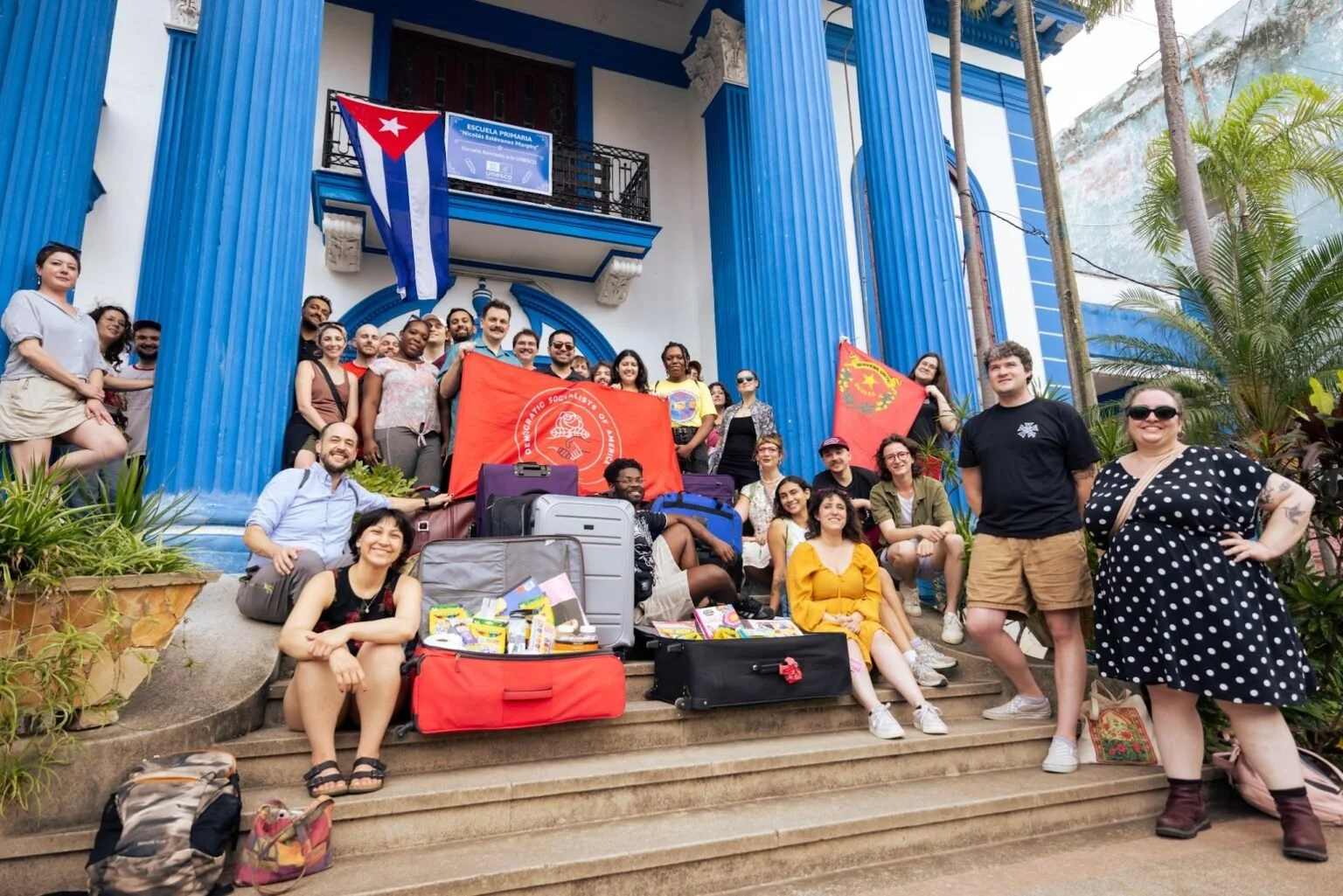
Delegation members with their donated school supplies in front of Nicolás Estévanez Murphy Primary School. | Photo by Brandon Tizol. | Accessed from democraticleft.dsausa.org
After lunch, we visited the Nicolás Estévanez Murphy Primary School to donate school supplies and see a microcosm of Cuba’s public education system. The Revolution established access to education as a constitutional right, and this starts at early childhood with literacy and social education programs, where students learn (for example) both how to read and maintain good hygiene. As part of guaranteeing the right to an education, there are high densities of public schools in cities, reducing the need for students to commute and allowing parents to be more active collaborators in their child’s education. Still, the rains from earlier in the day kept many students stuck at home with their streets flooded and impassable. Many classrooms sat empty. Those who remained played Pato, Pato, Ganso (Duck, Duck, Goose) in the school’s courtyard as the sun began to shine overhead. They will, hopefully, still remain in a society where universities are public and free, with majors in both the liberal arts and sciences available. If so, they will be the latest success stories of a public education system that not only meets its promise to develop the entire human being but maintains the steady supply of professionals needed to keep the socialist society running.
Expanding the Revolution
As part of this social education program, the Education Ministry works with CENESEX (National Center for Sexual Education) on a sex-education program that expands beyond biology to teach consent and healthy relationship building as well as safe-sex practices, starting as young as kindergarten. Mariela Castro (Fidel’s niece and Raúl’s daughter) chairs the institution housed inside a bright yellow villa with naturally lit courtyards. This state institute also provides both gender-affirming care and mental healthcare for transgender people. The humid, still air crept in while we were riveted by the recounting of CENESEX’s success in advocating for progressive gender and sexual policies within the state. Every window and door was wide open to atone for the power having gone out earlier that afternoon. Once we returned to the air conditioning of our bus, our trans members took the microphone. The material analysis is that the Cuban government is innovative in its use of state power to protect and care for its LGBTQ+ citizens. The emotional weight of that analysis, contrasted with the U.S. government’s use of state power to harm LGBTQ+ nationwide, quickly hit us all. They wept as they spoke, and we wept as we listened – less out of sadness over the dark reality at home but out of inspiration at the bright future that we now knew was possible.
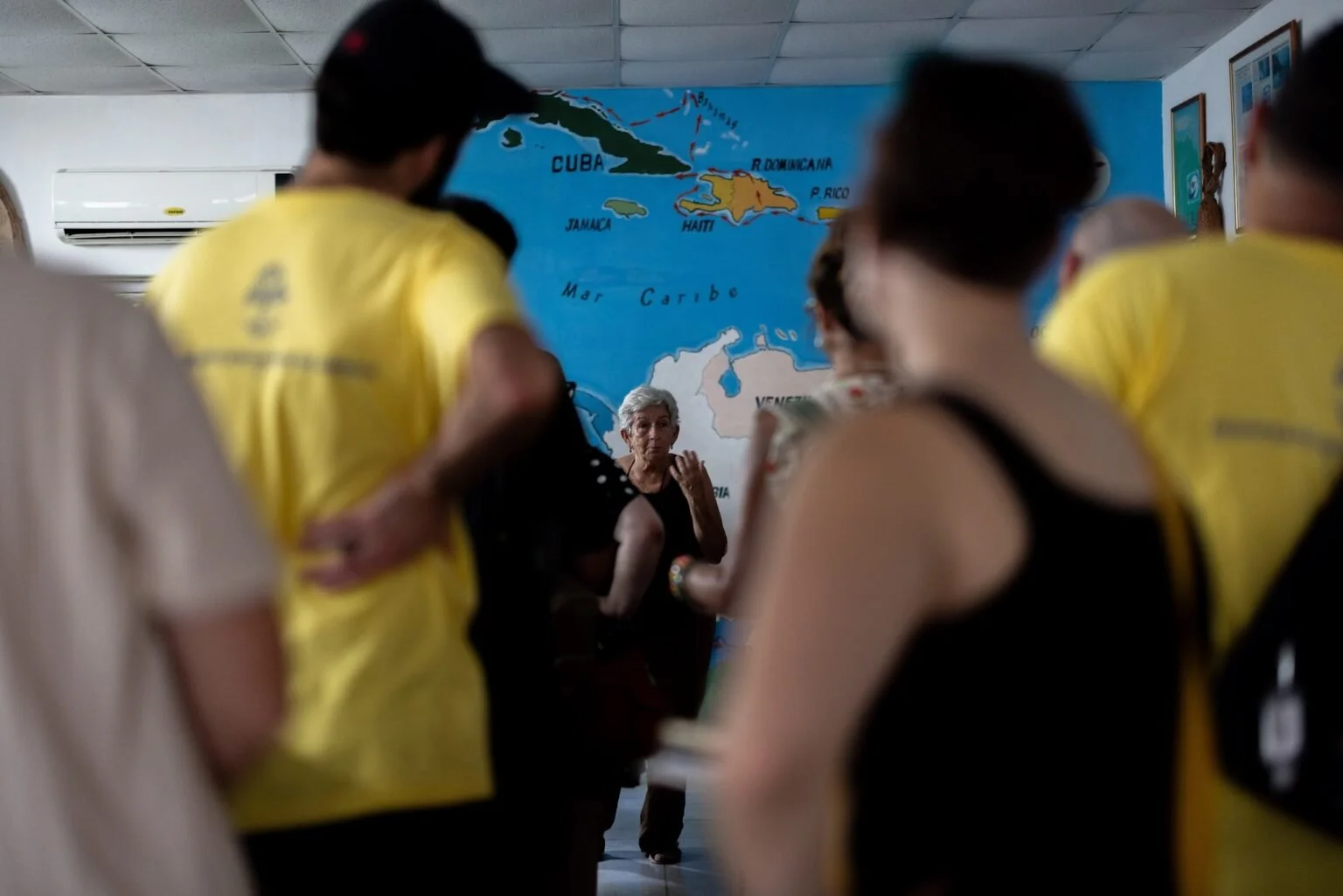
The delegation in a power outage-darkened room during the educational tour of the Nunez Jimenez Foundation | Photo by The delegation in a power outage-darkened room during the educational tour of the Nunez Jimenez Foundation | Photo by Brandon Tizol | Accessed from democraticleft.dsausa.org
The electricity had not returned when we reached the modest house that was home to the Fundación Antonio Núñez Jiménez de la Naturaleza y el Hombre. Núñez Jiménez, a former comrade of Che Guevara and a close advisor to Fidel on geography and anthropology, combined his investigation with a passion for Latin American history and socialism. The foundation he launched was the catalyst for the Tarea Vida, a comprehensive plan to address climate change through resource management, planned development, and infrastructure resilience. The plan also guided Cuba’s preparation for Hurricane Melissa, which struck Santiago and the eastern provinces less than three weeks after our delegation left the country. Cuba’s Civil Defense Force evacuated 735,000 residents from the area.
Twin Realities
It was apparent to all of us then that the lack of supplies is eroding the functionality of these core social services that are the humanist roots of Cuban socialism and society. A natural disaster such as the recent Hurricane Melissa only makes the situation worse. As a result of the evacuations, there were no deaths from the storm. There remain hundreds of communities without electricity and roads due to mudslides. The cost of the damage to Cuba is unknown, although overall damage to the Western Caribbean is estimated at over $50 billion. Already, Cuba’s allies in Vietnam and Mexico have recently arranged flotillas of supplies and oil to deliver as gifts. Since the U.S. has cut Cuba off from most of the global financial network, the Cuban government cannot receive the capital needed to reinforce or rebuild its infrastructure.
Our hotel was the one place in Cuba seemingly immune from the blockade and more closely resembled the setting of a season of White Lotus. Rum cocktails were available at a poolside bar dedicated to Zheng Yi Sao, the Chinese pirate who avenged her husband’s death by leading raids against the East India Company in the South China Sea. We spent our first night at a nearby bar, joking about how our DSA caucus rivalries were coming to an end over mojitos served out of glass skulls. Every room had air conditioning and running water; most had balconies overlooking Havana. Our luxurious detachment from the day-to-day reality of most Cubans is made possible by the same U.S. policies responsible for their material deprivation. We are only allowed to stay in privately-owned hotels due to Washington’s hostility toward state-owned enterprises. The irony of this restriction would reveal itself in the late afternoon of each day, when the skies would clear, revealing a vista of houses with fading paint nearby to lush trees and distant hills as the city gave way to countryside.
We also enjoyed various restaurants across Havana. Our first dinner took place at La Divina Pastora, overlooking Havana’s harbor, while a live band played Camila Cabello’s “Havana”. We played with the stray cat that roamed the patio where we ate. Our lunches were at collectively-owned restaurants such as the Jardin de los Milagros, where dishes are prepared using herbs and vegetables grown on site. The leaves of large plants and trees acted as a natural canopy, keeping us cool and out of the sun without using electricity or building supplies. Our dinner in La Torre presented us with 360-degree views of downtown Havana on a cloudless sunset. We opened the windows and snapped pictures of the panorama looking down on the quiet city below. When we were back on the ground, the departure of so many young adults in recent years was apparent as the streets and bars were empty. It made walking into the National Hotel very easy for us, and we sipped dark rum neat and smoked cigars before taking group pictures by its fountain. Due to the blockade, we were the only Americans who could enjoy this night out by the water.
Every drink we paid for and every tip we made was in U.S. dollars. Cuba’s attempts to manage the exchange rate between its peso and the U.S. dollar have not abated the informal dollarization of its economy taking place. Years of inflation and recession caused by Washington’s efforts to isolate Cuba economically have rendered the Cuban peso practically worthless. We prepared by only carrying small denomination U.S. notes.
Our currency couldn’t save us from the effects of our government’s policies. Climate change has not only made the hurricanes that hit Cuba stronger and more damaging, but they have made the days warmer and more humid. When the blackouts came, we drank liters of water and added electrolyte powders to ward off heat exhaustion as best we could. Without regular electricity for refrigeration and water filtration, food and water quality have fallen off, leading to a number of us suffering from food-borne illness during our first days back.
We then got to see the years of maximum pressure and decades of blockade’s cumulative toll on Cubans.
The Toll
Old Havana is near the twin forts the Spanish built on either side of the harbor. Its four main plazas housed the city’s first set of religious, political, and economic elites during the colonial era. You used to be able to tell how wealthy a family was by counting the number of arches in the facades of the buildings leading away from each plaza. Now, we could peek inside and see darkened interiors and decaying wooden scaffolds and stairs, faint faces of families living inside darkened apartments in disrepair, a begging mother appearing next to you with her hands out, a young boy showing off yo-yo tricks. We tried to keep together while walking through the narrow streets from plaza to the next, but there was no respite from the desperation and decay. The historical facades could not conceal the desperation of the people living inside. The reality overwhelmed us, and we knew that the only remedy we had, the spare dollar in our pocket, would never be enough. A few of us broke down that cloudy afternoon, weeping at our powerlessness.
A couple of drops of rain had fallen by the time we returned to the bus. I stared out the window as it passed Cuba’s halls of government toward a harborside artisan market. Those of us who’ve spent a day or a week with a zero in their bank account will know, as George Orwell put it, “the feeling of relief, almost of pleasure, at knowing yourself at last genuinely down and out.” My days of being down and out were temporary and, hopefully, well in my past. For the people we had just seen, every day is spent down and out.
I took a deep breath and eventually got off the bus, realizing I was too choked up to thank the driver. We arrived with only about 15 minutes to survey the various stalls for whatever souvenir or art piece caught our eye. I wandered down the middle aisles with vendors on both sides of me until I found one with simple bracelets made from wood and shell. The three bracelets I bought for each of my nieces cost $5. As I walked away, I decided to talk to the artisan.
He sat back and set aside the string and pieces he was combining to make his next bracelet. I wanted to know why this man with a hunch to his posture and a graying beard and fading black hair was working a full day at a souvenir shop. He explained that the $5 I paid will be more than what he earns in a day from his state pension. Like some members of our delegation, he has family in both Cuba and the United States. He left his sons in Philadelphia and returned to Havana after being diagnosed with throat cancer a few years ago. The treatment and housing he receives are cost-free, but business at the stall remains slow. I tucked the bracelets in my bag, bade the artisan farewell, and walked back to the bus.
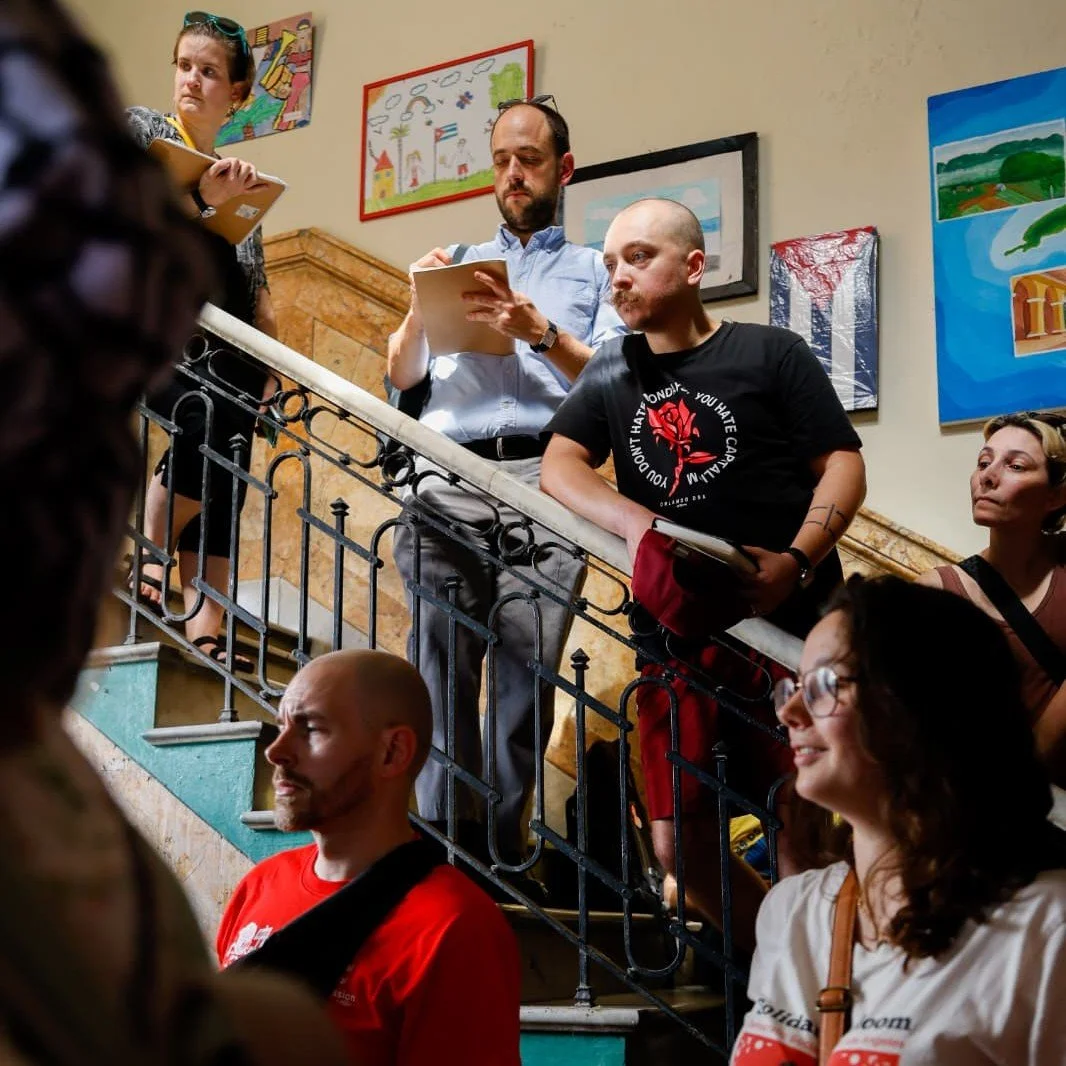
Delegation members on the tour of Nicolás Estévanez Murphy Primary School. | Photo by Brandon Tizol | Accessed from democraticleft.dsausa.org
The Project
My spirits were beginning to improve when I was prompted to look out of the window. The clouds had lifted enough to show sunset over the Gulf of Mexico. The waters near Havana were calm and guided my eyes toward the golden rays of sunlight shining on the horizon. I understood then that I had ridden the same emotional roller coaster as 39 other comrades. We made it through because we knew that a bright future is ahead for our Cuba solidarity project, because we were ready to turn our emotions into concrete organizing. Our final dinner took place near the sea, over a cloud of cigar smoke, and our table reflected on the collective journey that we paused our lives to embark on together. The 40 of us will have 40 different recollections of that journey and the country we saw. We also toasted the organization that brought us here.
DSA allows for a cross-pollination of perspectives and tactics to make up for its lack of wealth or state capacity. At this final gathering as a delegation, we heard how the members who staff food kitchens and community gardens back in the U.S. conceive of mutual aid shipments, from the labor organizers who draw up resolutions for their union calling for an end to the blockade, from lawyers ready to challenge the blockade’s constitutionality and from the political strategizers draw up methods for helping up-and-coming cadre electeds understand, defend and spread knowledge of the Cuban socialist project.
Over 200 DSA members applied for the second member delegation to Havana. Having been rejected from the first member delegation, I can empathize with those who were rejected from this one. We can only take 40 people and do the best we can to ensure that represents the broad diversity in demographics as well as the perspectives, tendencies, and forms of struggle within the organization. We will still need the 160 others to keep their commitment to Cuban solidarity and apply again when the next delegation occurs.
To that end, we are delighted to launch the Venceremos Fund, which will provide financial support for members participating in this and other DSA-organized delegations. You can support your comrades by donating here.
To continue the work, join DSA and the International Committee. Join the Cuba Solidarity Working Group, and together we will say “¡Cuba Si, Bloqueo No!”