
With Sawant, DSA Deserves Better
SMC Editorial Board Note: This piece is not an official caucus statement, but the opinion of the author.
For over a dozen years since Kshama Sawant won local Seattle office, her relationship with the Democratic Socialists of America has had its ups and down. Over the past half decade, she has been overwhelmingly harmful to DSA, which deserves better. DSA should be fostering a genuinely big tent, not welcoming entryism no matter who is in charge..
On March 21st, by a vote of 91-67, the annual local convention of the Seattle DSA chapter voted to not reopen their endorsement consideration period for former Seattle City Councilmember Sawant’s congressional campaign. Sawant was the Seattle City Council’s most prominent socialist for a decade. She and her supporters put forward a resolution to debate the endorsement of her candidacy against 29-year incumbent Congressman Adam Smith, including citing her DSA membership.
The resolution include language such as:
WHEREAS there is no other socialist politician in the U.S. who has more clearly and unambiguously fought for working class people and embodied the idea of how a socialist should use elected office.
If this self-aggrandizing language left room for doubt, the small Twitter account Movement for Kshama encouraged Seattle DSA members to support their candidate’s resolution because prominent socialist electeds were “sell outs” and decried “the failures of the DSA leadership.” (Sawant and this independent group are now fighting over Movement For Kshama’s attempt to gather signatures to qualify Sawant for the ballot in possibly improper and potentially illegal fashion.)
“For about five years, Sawant has not reciprocated DSA’s solidarity nor acted as a productive leader in our organization since becoming a member.”
The unsuccessful endorsement fight is one more episode in an avoidable and obvious tension between DSA with Sawant and her backers. The fight is, as it has always been, largely one-sided and led by her and her followers with DSA hardly responding in kind. For the sake of all parties involved, it should cease.
Let’s be clear: incumbent Congressman Adam Smith should be defeated. And if Sawant wants to do it, more power to her. Smith is a classic corporate “New” Democrat who, as Sawant explains, backs the worst of U.S. foreign policy. In my own professional and personal capacities, I have supported DSA members and chapter-backed candidates who have challenged him in the past: Sarah Smith (no relation) and Stephanie Gallardo.
However, his record alone doesn’t mean that DSA should support Sawant’s run. I’ll leave aside matters such as the “jungle primary” system (which disadvantages insurgent socialist candidates in blue states like Washington and California) or the process-oriented complaints about the Seattle DSA endorsement timeline.
My reason for opposing Sawant’s endorsement is simple: for about five years, Sawant has not reciprocated DSA’s solidarity nor acted as a productive leader in our organization since becoming a member.
To understand the full story of Sawant’s relationship with DSA, it is important to go back to the early 2010s – when Sawant rose to prominence in Seattle and the United States more broadly. At this time, socialists were not winning any critical mass elections: both within and outside the Democratic Party.
Bernie Sanders, at the time of Sawant’s first election and now, is the most well-known American socialist elected. He has always straddled both worlds by running as an independent on the Democratic ballot line and caucusing with the party at the federal level. Sawant, instead, focused on full independence.
In 2013, Sawant won her Seattle race as a Socialist Alternative candidate in a nonpartisan city council system. Socialist Alternative, AKA “SA”, is a U.S.-based Trotskyist group founded in 1986, that has, since then, embraced a full rejection of running candidates in bourgeois parties. Her victory prompted many, including myself, to question our long-held belief that we should run socialists primarily as Democrats. I personally volunteered to do opposition research (small example here) for Jorge Mujica’s 2015 independent socialist run for Chicago alderman, which publicly drew heavily from Sawant.
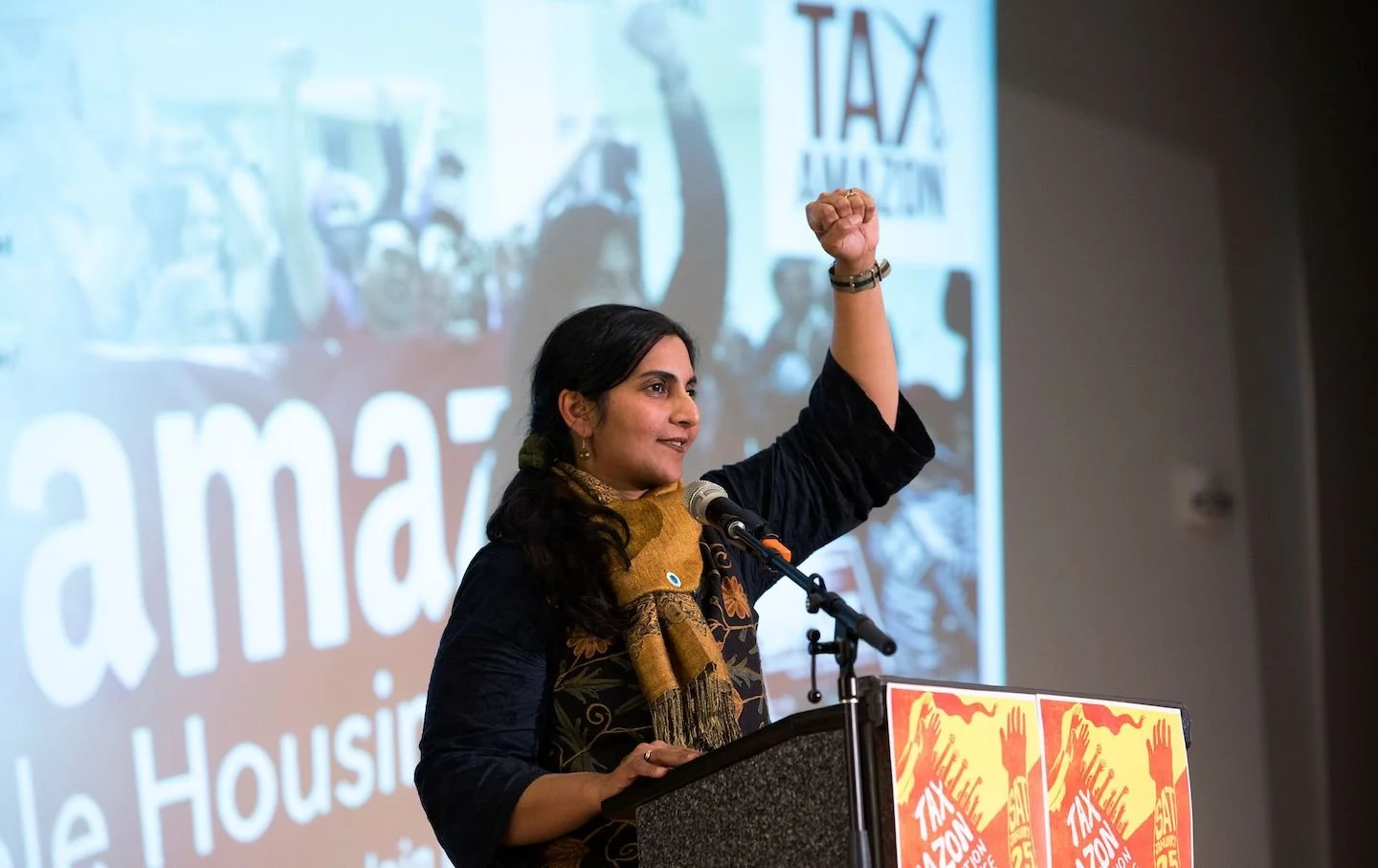
To Sawant and her then-organization's credit, her win did shift the terrain of what seemed possible – electorally and policy-wise. As she notes, during her time on city council, she was a champion of several successful legislative efforts such as raising the minimum wage to $15, securing a tax on Amazon, and the passage of many tenant protections. Her actions went beyond passing bills in pushing movements and coalitions to create the political will to enable passage into law.
However, over the course of her tenure, it became increasingly clear that Sawant’s victory as an independent socialist was the exception—not the rule. From 2017 to now, third-party and independent runs by leftists generated fewer victories than the hundreds of socialists elected on the Democratic ballot line. This reality becomes even more stark if you discount those “non-Democrats” who are winning in nonpartisan systems like Chicago and Seattle but are registered Democrats.
For me, the real test was Ginger Jentzen’s campaign for Minneapolis city council in 2017. Jentzen ran as an open Socialist Alternative (SA) candidate with the backing of national DSA and the local chapter, several unions including the powerful nurses union, as well as the Sanders-inspired Our Revolution. The left really wanted to see SA win and Jentzen even led in election day first-place votes but eventually lost in the ranked-choice voting runoff.
While today, current DSA and former SA member Robin Wonsley serves in the Minneapolis city council as an independent, her success outside of the Democratic Party ballot line is uncommon for DSA electeds. Furthermore, SA failed to replicate Sawant’s success anywhere else, even with support from other left-wing groups.
Sawant’s status as one of two most prominent socialist elected officials in the US was also not long-lasting. In the summer of 2018, DSA-backed organizer Alexandria Ocasio-Cortez won her primary against Democratic congressional leader Joe Crowley. This upset victory launched her to stardom and now she is arguably the second most-prominent socialist elected behind Sanders (with New York City Mayor Zohran Mamdani, who also ran on the Democratic ballot line, in the mix as well).
The enthusiasm within DSA for running outside the Democratic party had begun to wane by the end of the 2010s. As Socialist Majority Caucus member Rebecca Harshbarger wrote on The Agitator,socialists such as now-NY State Senator Jabari Brisport moved from the Green Party to the Democratic ballot line to win office. But what was more telling about Brisport’s story was that NYC-DSA developed a socialist line for his 2017 City Council run that received fewer votes than the GOP candidate, who got about four percent, even though Brisport got nearly 30% of the vote on two ballot lines. The chapter quietly abandoned seeking its own ballot line, as the immense petitioning effort required took away from other organizing work.
To her credit, Sawant was supportive of Sanders’s 2016 presidential run in the Democratic primary, although she maintained her principles and did not join the Democratic Party. Unfortunately, her political prospects in Seattle were threatened by increasingly fierce opposition by the business class.
Right-wing and corporate backlash against Sawant culminated in a recall effort about two years after her 2019 victory. Sawant even signed her own recall petition to demonstrate that she wasn’t afraid of democracy. DSA stood behind her; both national DSA and the Seattle chapter released statements in support, with the Seattle DSA chapter materially supporting Sawant through a specific subcommittee dedicated to her. The chapter hosted phonebanks & canvasses and an anti-recall rally featuring Meagan Day, a prominent DSA member and Jacobin senior editor, as Sawant acknowledged.
Sawant survived the 2021 recall by 310 votes, but it was a pyrrhic victory. In 2023, she declined to run for reelection and left Socialist Alternative completely to start Workers Strike Back – part anti-capitalist (but not explicitly socialist) activist group, part podcast. SA had already suffered a departure with key cadre entering DSA at the end of 2018, many of whom would be part of the Reform & Revolution caucus within DSA, which elected its first member of the National Political Committee (NPC) last year.
While Sawant became a DSA member in 2021, announcing her membership on a SA not DSA publication, her internal participation was short-lived. She and other members of SA served as delegates to the 2021 DSA National Convention, but their proposals were largely defeated, sometimes by 6-to-1 margins.
Afterward, Sawant retreated to criticizing DSA and its electeds more than she ever had praised the organization or shared in its successes. While Sawant did not publicly renounce her membership, she adopted the role of outside critic rather than seeking to change DSA from within. For example, Sawant dedicated an entire section of an April 2023 interview on Bad Faith to the so-called “DSA’s institutional failures.”
“The big tent does not function if people come in with a desire to make it over completely in their image and be closed to different views, as Sawant has done. Instead, it would be wise to take a page from the book of Schwartz and be open to more perspectives. That’s what DSA deserves.”
That same month, Young Democratic Socialists of America member Stephen Anthony on The Activist criticized Sawant’s decision not to stand for re-election and leave SA to form Workers Strike Back, while taking pot shots at DSA. This section from Anthony’s article sums up the unfairness of Sawant’s attacks:
In her statement, Sawant takes several jabs at DSA and DSA-elected officials. She makes the claim that “since I was elected in 2013, more than two hundred self-identified ‘democratic socialist’ candidates have been elected nationally. But unfortunately, with rare exceptions, the overwhelming majority of them have abandoned their campaign promises and have failed to stand up to the political establishment.” This statement is a little odd, considering that just on the Seattle city council, DSA-member Tammy Morales has been standing with Sawant in fighting corporate interests. This statement is also a little ridiculous, as it is very unlikely that Sawant can follow every vote from the hundreds of DSA officials at the state and local level across the nation.
While I can never claim to know what is in Sawant’s heart or mind, one fact is clear to me and should be to her as well. Becoming a leader within DSA would entail sharing the platform with many other people. Not since maybe Michael Harrington, and to a certain extent with my old friend Joe Schwartz (chair of the Steering Committee of the NPC during much of the early 2000s) has DSA had one de jure or de facto leader.
DSA has turned very much into a leader-full socialist collective. Beyond our two official co-chairs and the twenty-five member NPC, caucus leaders and intellectual lights all play a role in guiding the multi-tendency DSA membership and base. While Sawant was the principal figure to the public for many years for both Socialist Alternative and now Workers Fight back, she cannot simultaneously be a uniquely uncompromising and singular figure, and be actively involved in DSA’s internal politics.
Lastly, consider the advice Joe Schwartz gave to the 2017 NPC, the first one elected in the new DSA era, that they would both change DSA and be changed by it. Democratic discourse has challenged and shifted my own beliefs, which is both healthy and how a big tent organization is supposed to work.
The big tent does not function if people come in with a desire to make it over completely in their image and be closed to different views, as Sawant has done. Instead, it would be wise to take a page from the book of Schwartz and be open to more perspectives. That’s what DSA deserves.